On 21 October 2026, the PHP development team released security updates for two critical vulnerabilities in the PHP runtime. Both issues can lead to unauthenticated remote code execution under vulnerable conditions. For teams maintaining PHP-based applications, the immediate action is to identify affected installations and apply the relevant updates.
There is also a broader engineering lesson. A web application does not become secure simply because its framework, plugins and application dependencies are up to date. The runtime, container image, server configuration and deployment process remain part of its security boundary throughout the application's life.
This distinction matters for any organisation running a Laravel application, a CMS, a customer portal or a bespoke PHP backend.
What happened in October 2026?
The PHP project's security announcement identified two vulnerabilities, each rated 9.2 under CVSS v4.0:
- CVE-2026-109618 concerns memory handling around out-of-memory conditions. In certain situations, an interrupted request can leave internal request data partially initialised, leading to unsafe behaviour during cleanup.
- CVE-2026-109619 concerns stale internal state. State associated with one request may remain accessible after its backing memory has been freed, potentially affecting a subsequent request handled by the same worker.
The security fixes were released in these PHP versions:
| PHP branch | Fixed upstream version |
|---|---|
| PHP 8.5 | 8.5.12 |
| PHP 8.4 | 8.4.27 |
| PHP 8.3 | 8.3.36 |
| PHP 8.2 | 8.2.35 |
The advisory covers PHP installations serving web requests, including PHP-FPM, Apache mod_php, php-cgi, FrankenPHP and LiteSpeed. The PHP team identifies mod_php as a particularly high-risk configuration because a demonstrated exploit can execute before application code runs. That does not mean every deployment has the same exposure or that exploitation is equally straightforward in every environment.
PHP 8.1 and older no longer receive routine upstream security updates. Some commercial support and Linux distribution vendors may provide backported patches, so administrators should check their vendor's security notices rather than relying solely on the version number. PHP 8.2 is also approaching its upstream end of life on 31 December 2026, making upgrade planning important alongside the immediate patch.
On 23 October, PHP published separate guidance concerning session upload progress. It describes another potential remote-code-execution vector, CVE-2026-115560, requiring an unusual combination of session serializer configuration and runtime application behaviour. The PHP project recommends disabling session.upload_progress.enabled for affected setups until a regular release addresses it. This is separate from the two vulnerabilities patched on 21 October and should not be described as universally exploitable.
For an independent European public-sector assessment, see CERT-EU's updated PHP security advisory.
Why updating Laravel or a CMS is not enough
Consider a Laravel application with its dependencies updated, current authentication middleware and sound access controls. It may still be served by an older PHP-FPM process or a container image built before the security releases.
In that situation, the application code and the underlying execution environment have different security states. A Composer update changes PHP packages. It does not automatically patch the PHP interpreter running on the server.
The same distinction applies to WordPress, Statamic and custom PHP systems. A CMS, framework or plugin update cannot substitute for a PHP runtime update. Conversely, patching PHP does not remove the need to maintain the application, its dependencies and its configuration.
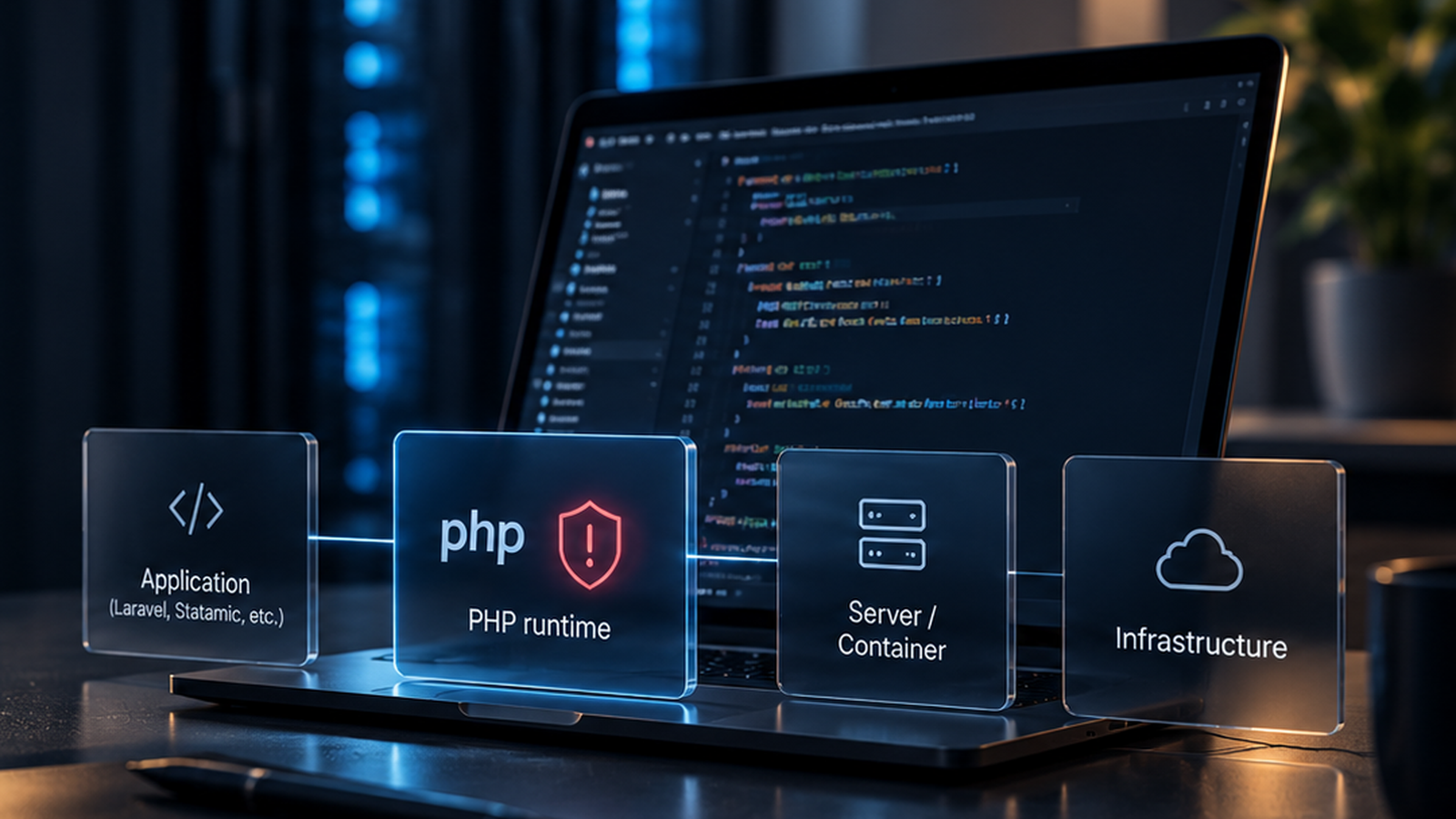
This is why software security must be understood as a responsibility across the complete stack:
Application and dependencies → PHP runtime → web server or container → operating system and infrastructure.
Each layer has its own update mechanisms, deployment steps and potential failure points. A secure release process needs visibility across all of them.
Where teams should look in production
The first challenge in an incident like this is often not installing a patch. It is identifying precisely where the vulnerable runtime exists.
- Inventory the deployed runtimes. Check public applications, internal tools, API services, staging environments and secondary services that use PHP. Include background workers and scheduled jobs in the inventory even if they are not directly exposed to web traffic. Identify whether each workload uses PHP-FPM, mod_php, CLI workers or another integration.
- Identify who supplies the PHP binaries. A managed hosting provider, Linux distribution, Docker base image, control panel and source-built PHP installation may all have different update paths. For vendor-supported packages, read the vendor's actual patch advisory. A patched distribution package may retain an older-looking version string because security fixes have been backported.
- Rebuild and redeploy where necessary. Updating a Dockerfile or pulling a newer base image is not the same as replacing a container already running in production. Build and test the replacement image, deploy it, and ensure the previous vulnerable workloads are removed or restarted. Where images are pinned by digest, update the digest intentionally rather than assuming a mutable tag has changed the running software.
- Verify the runtime actually serving requests. A local
php -vresult is useful for identifying a CLI installation, but it does not by itself establish which PHP runtime the web server is using. Verify the effective runtime version and package build for each production service, including PHP-FPM pools and containers, through appropriately secured operational checks. Do not expose a publicphpinfo()diagnostics page merely to confirm the version. - Check the application after the deployment. Run application and integration tests, inspect errors and logs, confirm routes and background jobs still operate, and monitor the rollout. The goal is not simply a successful package installation. It is a patched, functioning production service with evidence of verification.
These steps are part of deployment engineering, not a replacement for specialist penetration testing or a comprehensive security assessment.
What if an immediate update is not possible?
The PHP project's position is clear: updating to a fixed release, or applying the appropriate vendor-provided fix, is the complete remediation for the October 21 vulnerabilities. The published configuration mitigations reduce exposure to particular attack paths but do not make an unpatched installation safe.
Where a patch cannot be deployed promptly, teams should perform a risk assessment and consider restricting or isolating affected internet-facing services until a verified fix can be applied. Changes involving request limits, memory settings or session upload progress should follow the PHP project's advisory and be tested against the application's real behaviour. They should not be treated as universal configuration recipes or substitutes for patching.
An additional operational consideration is ownership. Someone needs to know which assets are affected, who can deploy the change, how it will be tested, and how successful remediation will be confirmed. Without that clarity, even a publicly available security fix can remain unapplied.
Security does not end at deployment
The October PHP vulnerabilities are an example of why production software needs a maintained operational lifecycle. A system can be correctly implemented at launch and become exposed later through a newly discovered runtime defect, an outdated image or a neglected service.
For software teams, that translates into a few continuing responsibilities: maintain a reliable inventory of deployed components; know which vendors provide updates; establish tested patch and rollback procedures; monitor production environments; and plan upgrades before dependencies reach end of life.
At Cognivox Labs, this perspective connects our work in Backend & API Engineering with Cloud & DevOps Engineering. The application logic and the environment running it should be designed, deployed and maintained as parts of the same system. Our earlier article on Laravel in 2026 discusses the framework's application-development strengths; the PHP incident illustrates why operational security matters alongside those strengths.
The topic is particularly timely as it-sa Expo&Congress 2026 takes place in Nürnberg this week. Secure software delivery is not just about preventing vulnerabilities in new code. It also depends on how teams manage the infrastructure and software already in production.
For organisations reviewing an existing PHP application or planning a new one, the right starting point is often a straightforward technical assessment: what is running, how is it deployed, who maintains it and what happens when a critical update is released?