There is no shortage of discussion about artificial intelligence in industry.
New models arrive constantly. AI agents are becoming more capable. Open-source models can increasingly be deployed within private infrastructure. Multimodal systems can work across text, images and other forms of information.
But when an AI system moves from a demonstration into a real operational environment, model capability is only one part of the problem.
For many organisations, the bigger challenge is the information surrounding the model.
Operational knowledge is rarely in one place
Consider a manufacturing or engineering organisation.
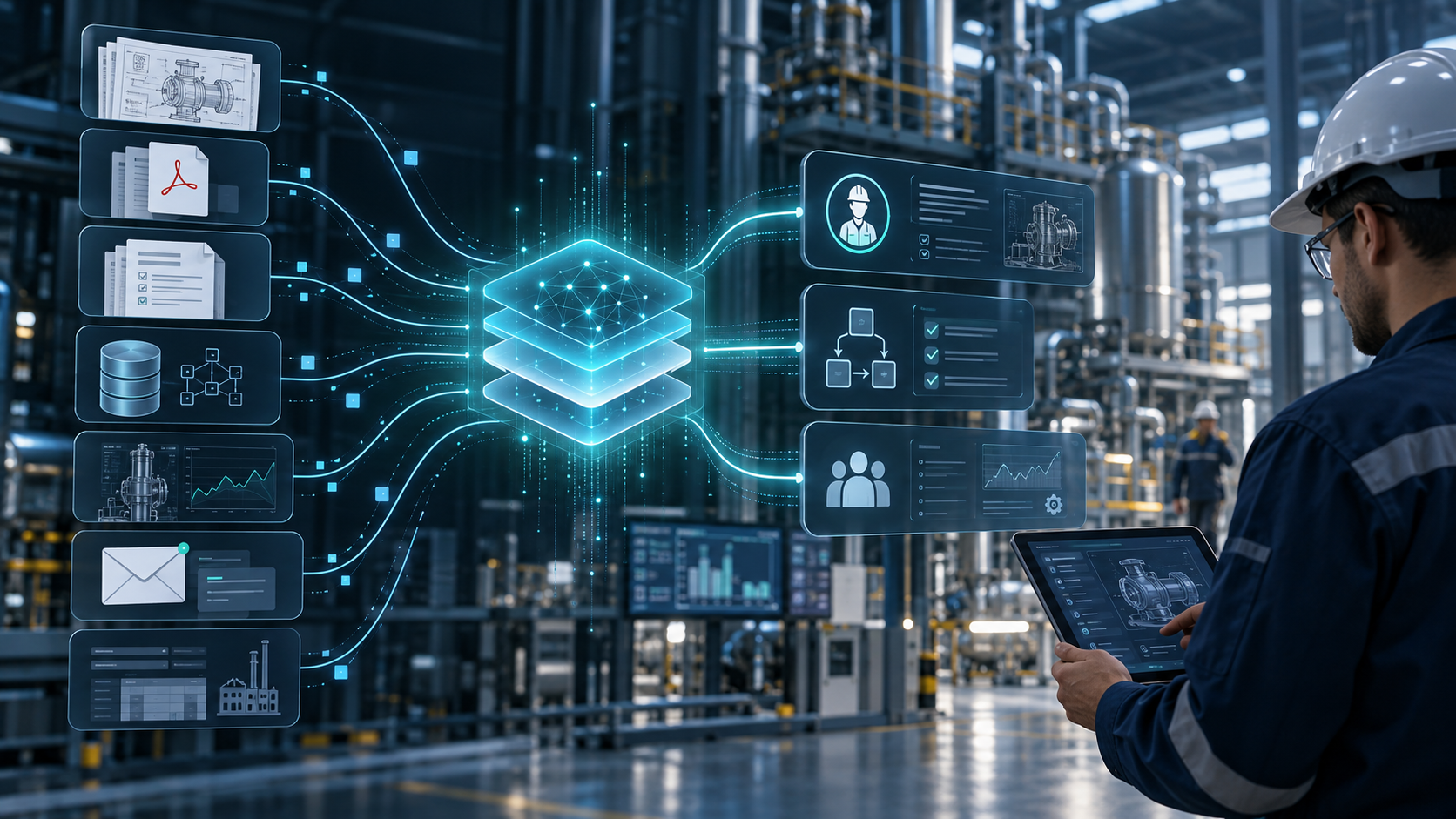
Important knowledge may exist across technical manuals, standard operating procedures, maintenance instructions, product specifications, service records, internal databases, ERP systems, SharePoint environments, emails and historical project files.
Some of the most valuable information may not even be formally documented. It may exist primarily in the experience of senior engineers and long-serving employees.
An AI assistant cannot create a reliable knowledge layer simply because an organisation has access to a capable language model.
The surrounding architecture matters.
A production system needs to understand where information comes from, which information is authoritative, who is allowed to access it and how an answer can be traced back to its source.
Retrieval is only the beginning
Retrieval-Augmented Generation, or RAG, is one approach to connecting language models with organisational knowledge.
At a basic level, the concept is straightforward: retrieve relevant information and provide it to the model before generating an answer.
In production environments, however, considerably more is required.
Documents must be processed correctly. Retrieval quality has to be evaluated. Different information sources may require different strategies. Permissions must be respected. Sources should be visible to the user. Older or conflicting documents need to be handled appropriately.
And the system needs a way of determining whether the generated answer is actually useful.
This is where the engineering challenge becomes much more interesting than simply connecting an API to a chatbot interface.
Industrial AI should connect with existing systems
Most established companies are not starting with a blank technology stack.
They already have ERP systems, databases, document repositories, internal applications, APIs and specialised operational software.
The opportunity for AI is therefore often not to replace those systems.
It is to create an intelligent layer across them.
Imagine a service engineer being able to ask:
“What troubleshooting procedure applies to this equipment configuration?”
The answer could combine information from the relevant technical manual, historical service knowledge and equipment data, while showing exactly where the information came from.
Or consider a workflow involving supplier documents.
Instead of manually opening a PDF, extracting values, checking them against specifications, entering the information into another system and sending an email when something is wrong, parts of that workflow can potentially be extracted, validated and orchestrated automatically.
The value comes from the complete workflow, not from the LLM by itself.
The same principle applies to automation
There is also a tendency to frame AI adoption around complete automation.
That is not always the right objective.
Some operational processes require human judgement. Others involve regulatory or safety considerations. In many situations the better system is one where AI reduces the amount of repetitive work while keeping the responsible employee in control.
That might mean automatically retrieving information, preparing a recommendation, highlighting an anomaly or drafting the next action rather than autonomously executing the entire process.
The appropriate level of automation should follow the business process, not the capabilities of the technology.
From AI experiments to useful systems
At Cognivox Labs, our interest is increasingly in this intersection between AI, organisational knowledge, operational workflows and existing enterprise systems.
The question we find most useful is not:
“Where can we add AI?”
It is:
“Where is information difficult to access, where is unnecessary manual work occurring, and where does that create a measurable operational constraint?”
The technology comes afterwards.
This perspective is particularly relevant as we prepare to attend the AMI Compounding & Recycling Expo Europe in Frankfurt.
Manufacturing, recycling and process industries provide exactly the kind of environments where technical knowledge, complex workflows, specialised systems and experienced people intersect.
We are interested in understanding where AI and custom software are already creating meaningful value in these environments, and, equally importantly, where the practical limitations remain.
Because the strongest industrial AI systems will probably not be the ones with the most impressive model demonstrations.
They will be the ones that quietly make the right knowledge available, inside the right workflow, to the right person, at the right time.