
Skip to content
Cognivox Labs

RAG & Knowledge Systems

Turn scattered knowledge into answers people can trust.

We build knowledge systems that connect private documents, business data and domain expertise with intelligent retrieval and language models — giving users relevant answers with traceable sources.

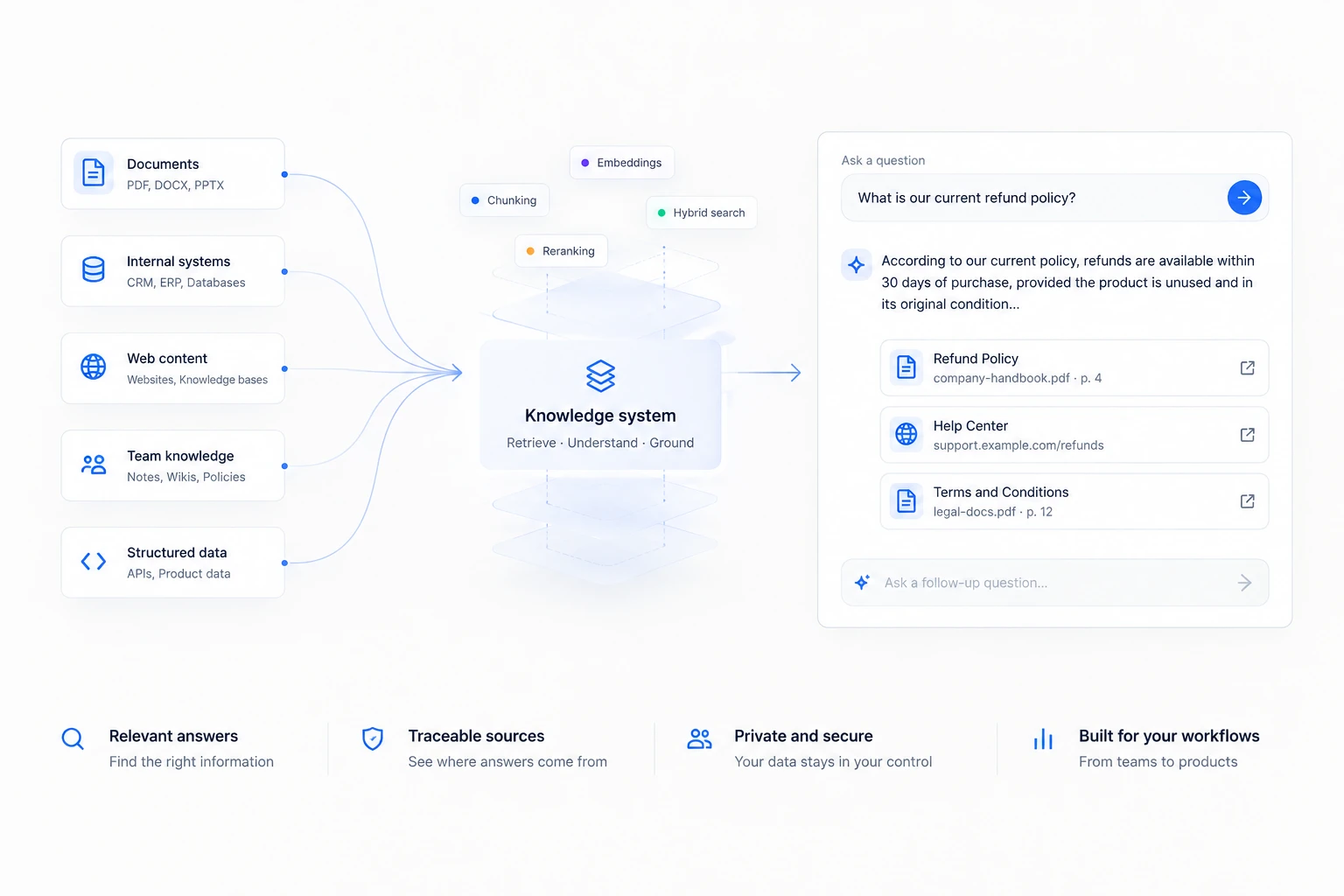
Documents, internal systems, web content, team knowledge and structured data feed a retrieval layer with chunking, embeddings, hybrid search and reranking. A user receives a grounded answer with source references.

From information to useful knowledge

Your company already has the knowledge. The challenge is making it usable.

Important knowledge often lives across documents, manuals, policies, reports, product data, internal systems and team resources.

Traditional search can help locate files and keywords. A well-engineered knowledge system goes further — retrieving relevant context, connecting information and helping users understand where an answer came from.

What we build

Knowledge systems built around how information is actually used.

The right solution depends on who needs the knowledge, where it lives and how the retrieved information will be used.

  1. Internal Knowledge Assistants

    Ask questions across internal documentation, policies, manuals, reports and business knowledge with clear source visibility.

  2. Semantic & Hybrid Search

    Search information by meaning and context while combining semantic and keyword retrieval where appropriate.

  3. Document Intelligence

    Extract, structure, retrieve, compare and explain information across document-heavy workflows.

  4. Support & Expert Knowledge Systems

    Give employees, customers or specialist teams faster access to trusted domain knowledge.

  5. Retrieval APIs & Knowledge Layers

    Reusable retrieval infrastructure that applications, internal products or AI systems can consume.

  6. RAG Evaluation & Optimisation

    Measure and improve retrieval relevance, grounding, answer quality, latency and operating cost.

From source to grounded answer

Retrieval is what connects company knowledge to useful answers.

  1. Knowledge Sources

    Documents, databases, knowledge bases, internal systems and structured data.

  2. Prepare

    Parse, structure, chunk, enrich and attach useful metadata.

  3. Retrieve

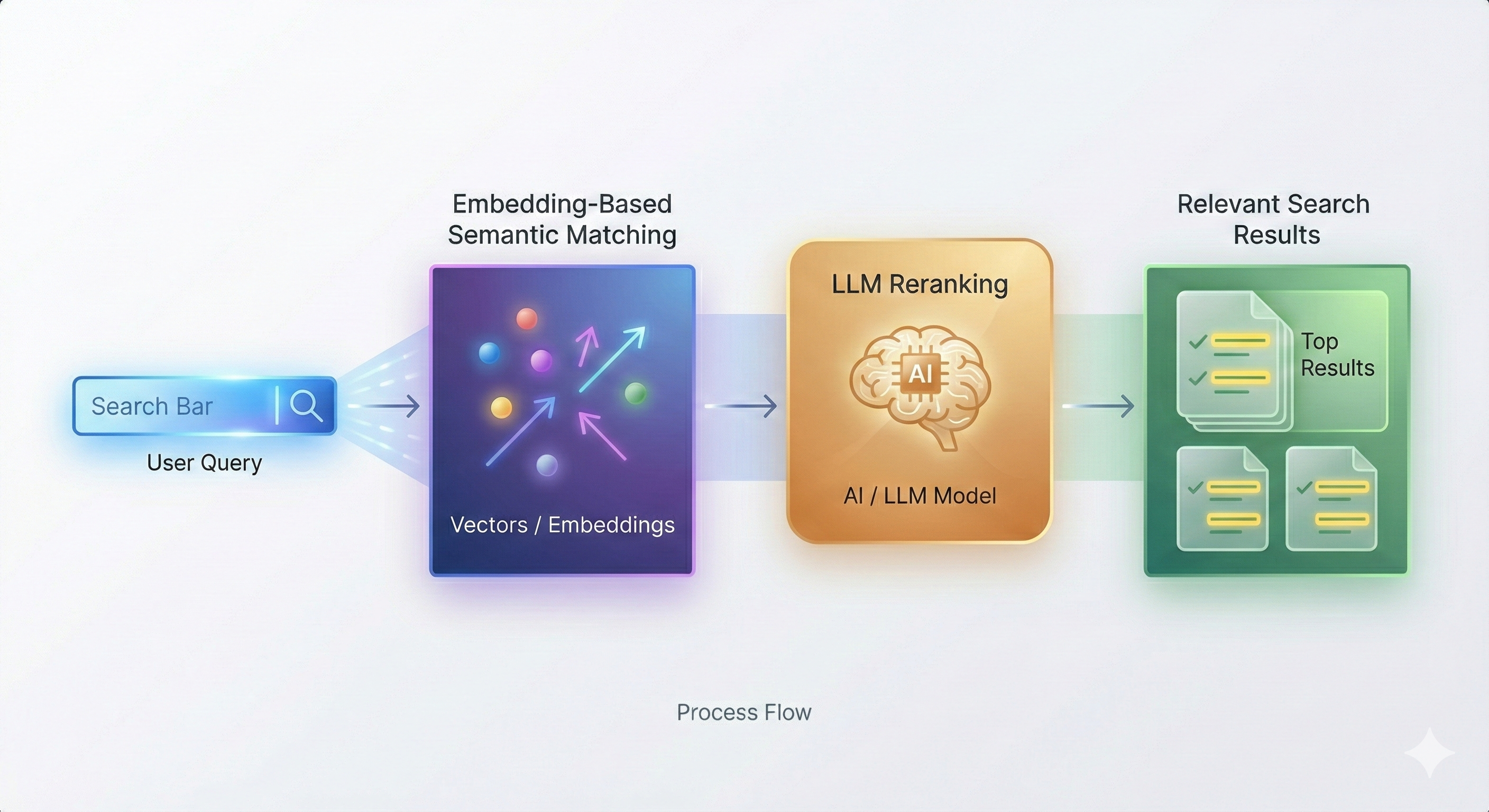
    Use semantic, keyword or hybrid retrieval to identify relevant context.

  4. Rerank

    Prioritise the most relevant information before it reaches the model.

  5. Generate

    Use retrieved context to produce a grounded answer.

  6. Cite

    Expose the underlying sources so users can verify important information.

Retrieval quality

The model can only work with the context it receives.

A strong language model does not compensate for poor retrieval. The system has to find the right information, preserve the relevant context and make the result measurable.

Find the right information
Retrieval, metadata filters, semantic similarity, keyword matching and ranking help identify the most useful source material.
Preserve the right context
Document structure, chunking strategy and metadata influence whether retrieved information remains meaningful.
Ground the response
Relevant context, source awareness and citation patterns help keep the answer connected to the underlying knowledge.
Measure whether it works
Test retrieval and answer quality systematically rather than relying only on demo impressions.

Access & knowledge boundaries

The right answer should also come from the right information.

Internal knowledge systems often contain information that should not be equally visible to every user. Retrieval architecture therefore needs to respect identity, permissions and data boundaries.

  1. User
  2. Identity & permissions
  3. Allowed knowledge
  4. Retrieval
  5. Grounded answer
Permission-aware retrieval
Limit retrieval to the content a user or role is allowed to access.
Tenant and data separation
Keep customer, team or organisational knowledge boundaries clear where multi-tenant architecture is involved.
Private deployment choices
Use deployment and model approaches appropriate to the sensitivity of the data and operational requirements.
Source visibility
Expose the material supporting important answers rather than presenting the model response as unquestionable truth.

Evaluation

A knowledge system should be measurable, not merely impressive in a demo.

Production quality depends on systematically testing both retrieval and answers against representative questions and real usage.

  1. Test questions
  2. Retrieve
  3. Answer
  4. Evaluate
  5. Improve

Feed improvements back into the next test.

Retrieval relevance
Does the system retrieve the information needed to answer the question?
Context quality
Is the retrieved context useful, focused and sufficiently complete?
Grounding
Is the answer supported by the provided knowledge?
Answer relevance
Does the response actually address the user’s question?
Latency & cost
Can the system perform well enough for the intended production use?
Human review
For important use cases, domain experts can remain part of the evaluation and improvement loop.

How we work

From knowledge sources to a production system.

  1. Understand

    Clarify users, knowledge sources, common questions, data boundaries and success criteria.

  2. Prepare

    Parse content, define document structure, metadata and indexing strategy.

  3. Retrieve

    Design semantic, keyword or hybrid retrieval, filters and ranking.

  4. Ground

    Connect retrieval to the model, context strategy, response generation and source references.

  5. Evaluate

    Test retrieval and answers systematically and improve weak areas.

  6. Operate

    Deploy, monitor, collect feedback and continue improving the system.

System architecture

Designed as a system — not just a prompt connected to a vector database.

Production knowledge systems bring together product experience, retrieval, models and infrastructure. Each layer should be replaceable and able to evolve as requirements change.

Model and deployment choices depend on the project. A system may use commercial model APIs, private deployments or open-source models depending on data sensitivity, performance, cost and operational requirements.

  1. Application experience

    Search · Assistant · Internal Tool · Product Feature

  2. Knowledge & retrieval layer

    Parsing · Metadata · Indexing · Search · Reranking · Permissions

  3. Model layer

    Generation · Embeddings · Evaluation

  4. Infrastructure

    APIs · Storage · Deployment · Monitoring · Security

Selected work

Retrieval and knowledge systems in practice.

Semantic Search & Automated Matching Pipeline

Semantic retrieval · Production integration

Semantic Search & Automated Matching Pipeline

A Python/FastAPI semantic search and matching service integrated into an existing Laravel application. Matching and scoring run through automated triggers and background workers, with REST endpoints bringing the results into the live product.

Read the case study

Related service

Need the system to take actions too?

Trusted knowledge can also become part of AI workflows that interact with tools, systems and business processes.

Explore AI Agents & Workflow Automation

Knowledge that works

Make your company knowledge easier to find, use and trust.

Tell us about your knowledge sources, users and the questions the system needs to answer. We can help shape the retrieval, model and production architecture around the real use case.

Start a knowledge systems discussion