
Skip to content
Cognivox Labs

AI MODELS & MULTIMODAL SYSTEMS

AI systems adapted to your domain, data and infrastructure.

We help organisations select, adapt, train and deploy AI models for specialised applications — from language and vision models to multimodal systems, private open-source deployments and production inference infrastructure.

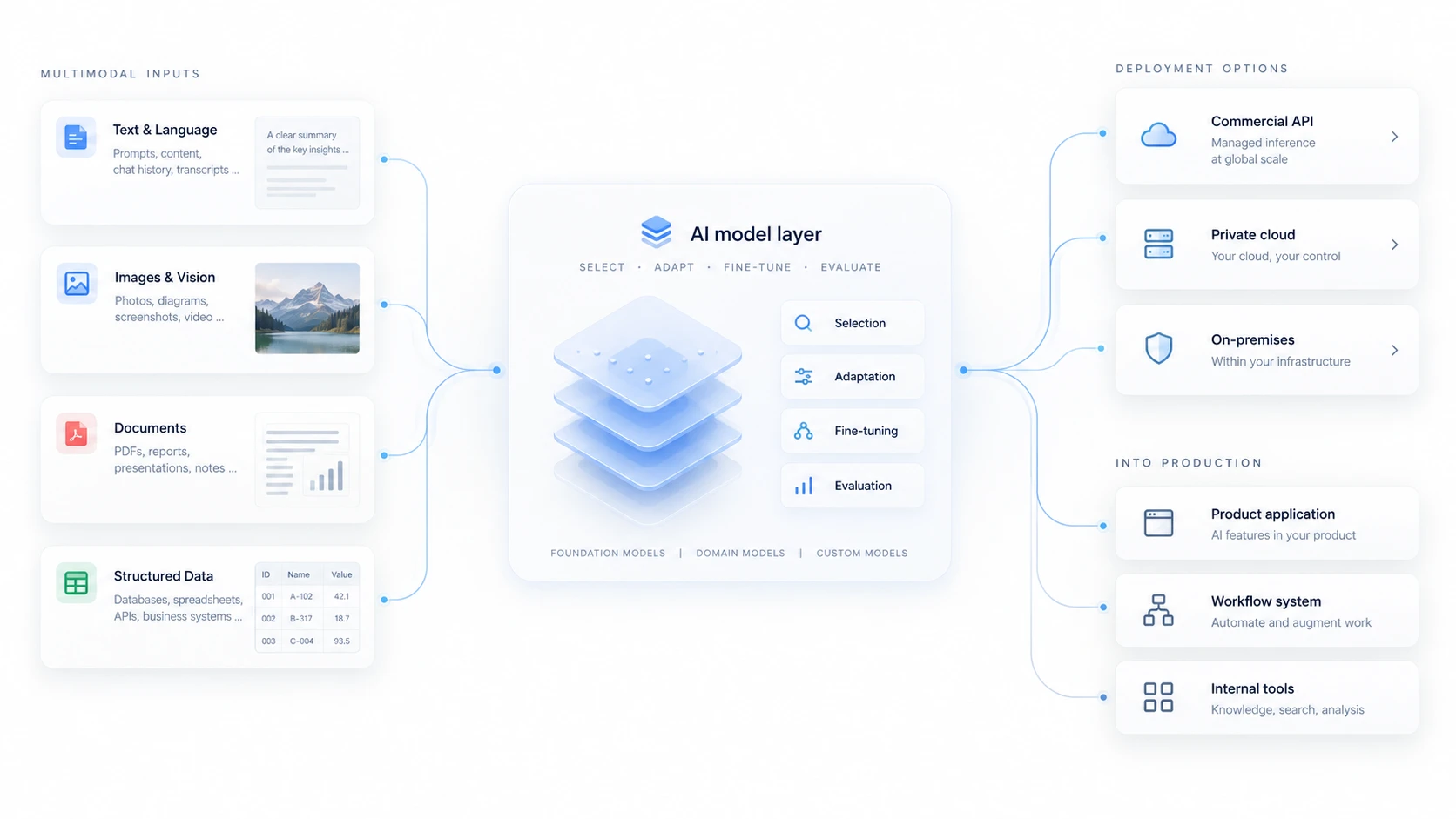
AI models and multimodal systems architecture diagram showing multimodal inputs on the left, AI model layer in the centre, and deployment options and production outcomes on the right.

MODEL & DEPLOYMENT STRATEGY

Use the right model — and run it in the right place.

The best AI architecture is not always the largest model or the most popular API. Data sensitivity, performance, cost, customisation and operational requirements all influence the right model and deployment approach.

A

Commercial Model APIs

For applications where speed of implementation, access to leading models and managed infrastructure are important.

Fast implementation · managed infrastructure · usage-based cost · externally hosted inference

B

Self-hosted Open-Source Models

Deploy open models on dedicated GPU infrastructure in a private cloud environment.

Private inference · infrastructure control · model choice · custom optimisation · production serving

C

On-Premises / Private Infrastructure

Deploy models inside customer-controlled infrastructure when information or operational requirements make external inference unsuitable.

Controlled environment · tighter network boundaries · private data handling · customer-managed infrastructure

Hybrid approaches are also possible, for example combining private models for sensitive workloads with managed models elsewhere.

WHAT WE BUILD

Model engineering from experimentation to production.

The right model solution depends on the task, the data, the deployment requirements and how the system will be used in practice.

  1. Model Selection & Adaptation

    Evaluate open-source and commercial models against the use case, data, quality requirements, deployment constraints and operating cost.

  2. Fine-Tuning & Domain Adaptation

    Supervised fine-tuning, instruction tuning, LoRA/QLoRA and other adaptation strategies where they materially improve domain behaviour.

  3. Computer Vision

    Classification, detection, visual inspection, image understanding and domain-specific vision workflows.

  4. Multimodal AI Systems

    Applications combining text, images, documents, structured information and other inputs within one system or workflow.

  5. Model Deployment & Inference

    Production inference APIs, private model serving, GPU infrastructure, model versioning, monitoring and integration into software products.

MODEL ADAPTATION

Not every problem needs a model trained from scratch.

Depending on the use case, the right approach may be prompt and inference optimisation, fine-tuning an existing model, adapting a vision model, continued training on domain data, or training a specialised model around a defined task.

  1. 01

    Use existing model

  2. 02

    Prompt / inference optimisation

  3. 03

    Fine-tuning / LoRA

  4. 04

    Domain adaptation

  5. 05

    Specialised training

We choose the least complex approach that can reliably meet the required quality.

MULTIMODAL AI

Some problems require more than text.

Multimodal systems combine several forms of information to understand a situation more completely — for example, images alongside metadata, documents alongside structured records, or visual input alongside user context.

Multimodal Processing Architecture

Text
Images
Documents
Structured Data
Metadata
Context
Engineered Core

Multimodal AI system

Operational Output

Decision / Workflow / Product feature

Applied Multimodal Scenarios

Visual inspection
Image understanding combined with product, operational or domain context.
Document understanding
Text, page layout, visual structure and extracted fields used together.
Integrated product intelligence
AI features that combine several data types within a product or workflow.

FROM MODEL TO PRODUCTION

A model is only useful when its quality can be measured and its operation can be trusted.

  1. 01

    Evaluate

    Compare candidate models against representative data and requirements.

  2. 02

    Adapt

    Fine-tune or optimise where the baseline model does not meet the use case.

  3. 03

    Validate

    Use test sets, metrics and expert review to understand real performance.

  4. 04

    Deploy

    Serve the model through the appropriate API, GPU infrastructure or private environment.

  5. 05

    Monitor

    Track inference behaviour, performance, cost, versions and feedback.

Human expertise remains part of the system where it matters.

For specialised or higher-risk applications, expert review, confidence thresholds and feedback workflows can remain part of the solution rather than treating every model output as automatically correct.

SELECTED WORK

Applied AI systems in practice.

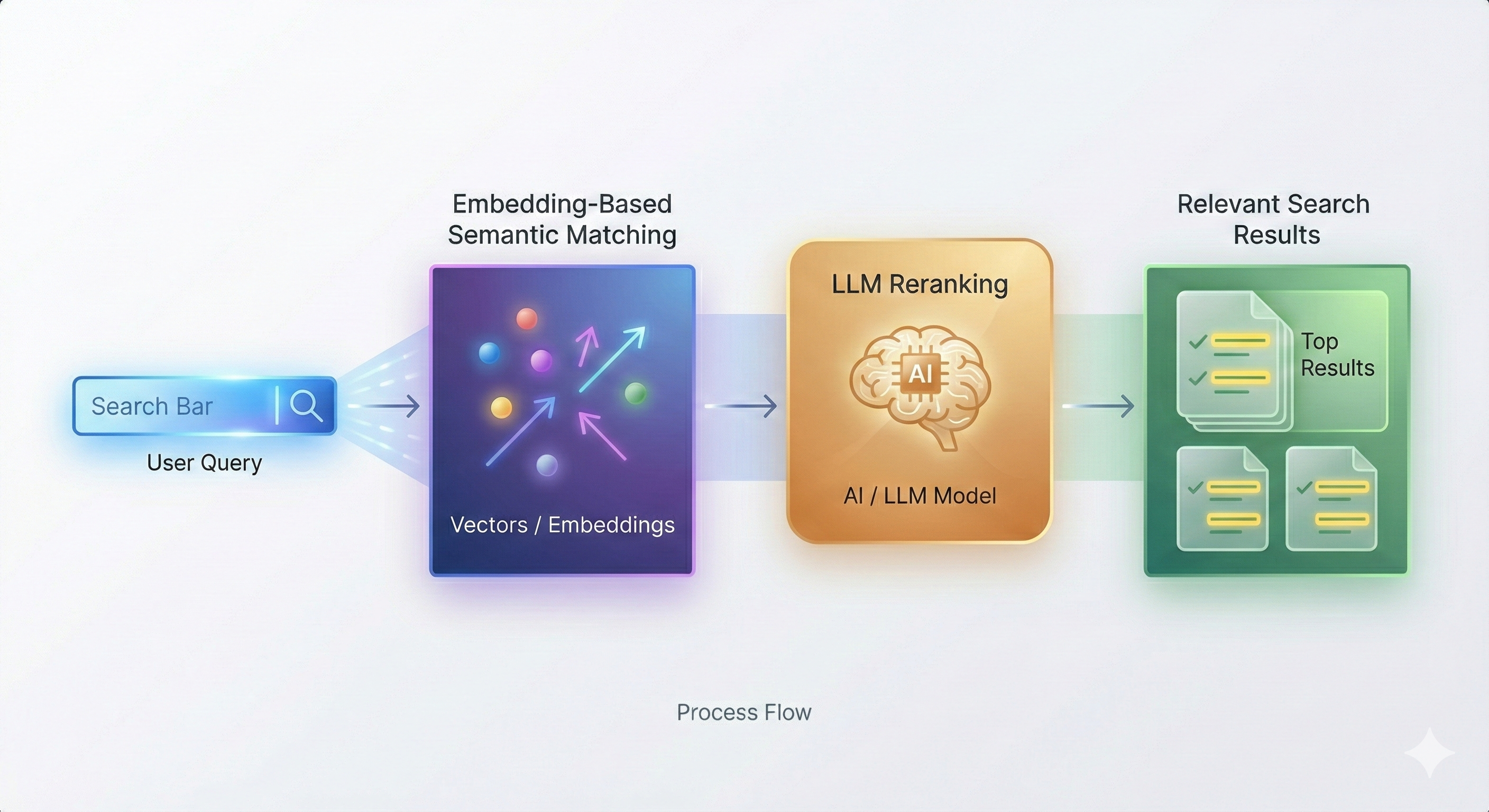
Semantic Search & Automated Matching Pipeline

Production AI Pipeline · Inference Deployment

Semantic Search & Automated Matching Pipeline

Engineered a Python-based semantic matching service and deployed it into production with FastAPI endpoints, secure service communication, background workers, and automated triggers.

Read case study

Applied AI Document System

BriefyMate

Designed and engineered an AI-assisted document generation application with structured prompt workflows, formatting constraints, and responsive web delivery.

Read case study: BriefyMate

Applied AI Engineering & Infrastructure

Python · PyTorch · Hugging Face · LoRA · QLoRA · vLLM · Ollama · FastAPI · GPU Cloud & Dedicated Inference · Docker · CI/CD

RELATED SERVICES

Need private knowledge retrieval?

RAG & Knowledge Systems

Grounded retrieval, enterprise document search and traceable answers.

RAG & Knowledge Systems

Need the AI to take actions across systems?

AI Agents & Workflow Automation

Connected AI agents, tool use and operational automation.

AI Agents & Workflow Automation
Looking for the infrastructure layer around your models?Cloud & DevOps Engineering

MODEL TO PRODUCTION

Need an AI model strategy beyond a standard API integration?

Tell us about the use case, data, deployment constraints and quality requirements. We can help evaluate the right model, adaptation approach and production architecture.

Discuss an AI project